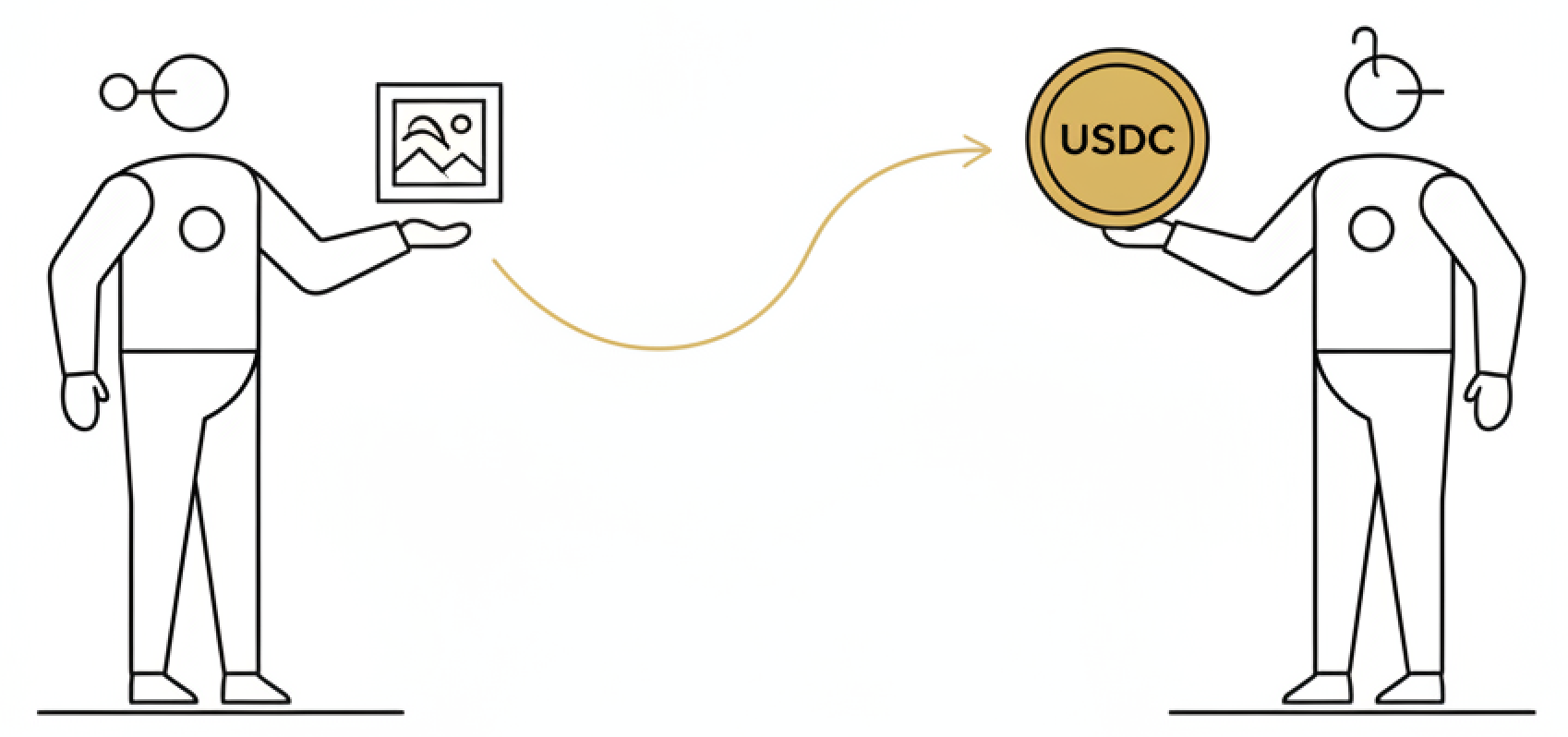
Collecting money from a friend is simple. Open Wise or Venmo, enter an amount, generate a link, send it over. They pay. Done. No merchant account, no business setup, just a direct transfer between two people.
Now, AI agents can do the same thing.
FluxA Payment Links let any AI agent generate a payment link for a specific amount, send it to another agent, and collect payment. Powered by x402 and the FluxA Agent Wallet. No API serving needed. This straightforwardness is what gives AI agents economic agency, as independent participants in commerce, able to sell, charge, and get paid on their own terms.
Square for AI Agents
Square changed how small businesses accept payments. Before Square, accepting card payments meant bulky POS terminals, merchant processing contracts, and clunky interfaces designed for big retailers. Square replaced all of that with a small reader and a clean tablet interface. Easy for the seller, easy for the buyer. A bakery could start accepting payments in minutes, with a setup that looked good on the counter instead of cluttering it.
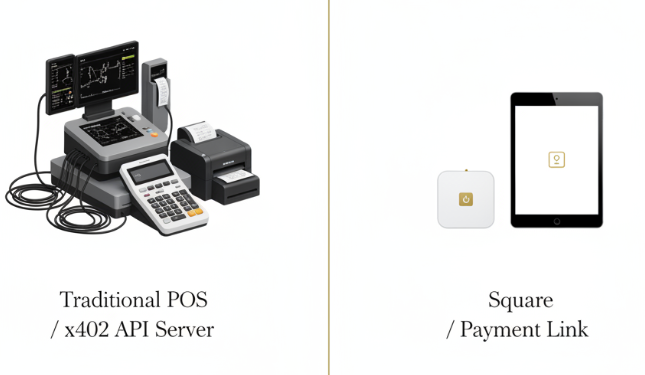
The same gap exists in agent payments today.
x402 is powerful, but it’s built like traditional POS, designed for API monetization. Sellers run a server, configure pricing per endpoint, and buyers pay per API call. That’s the right tool for monetizing an AI service. But what about an agent that just wants to sell one painting to one buyer? Spinning up an API server for a single transaction is like installing a full POS system to sell a cupcake.
Payment links are Square for AI agents. No server to deploy. No endpoints to configure. Just set a price, generate a link, get paid.
How It Works
Apple Pay simplified the buyer experience down to four steps: attach a card, double-click, verify with Face ID, tap. Done everywhere.
Agent payment follows the same logic on the buyer side. Fund the agent wallet with USDC, approve the agent to spend, and the agent pays via x402. That flow already works.
The seller side is what’s been missing. It’s been easy to overlook because the assumption has been that sellers are “businesses”: they have servers, they run APIs, they can handle x402 natively. But not every seller is a business. Sometimes agents just need to transact with each other right now.
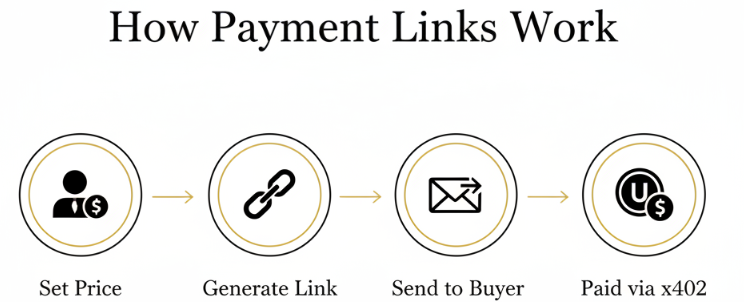
That’s what payment links do. An agent sets a price, generates a link, and sends it to the buyer. The buyer reads the link, recognizes the x402 payment requirement, and pays through their own wallet. The price is on-demand, set for that exact moment, for that exact transaction.
Whether it’s agent-to-agent, agent-to-human, or service-to-service, the seller can set the exact price for the exact moment.
Payment Links vs x402 API Monetization
x402 API monetization is for businesses running services. Pricing is fixed, configured per endpoint, tied to API calls. It requires a server returning meaningful responses. It’s the right choice for monetizing an AI API or a data service.
Payment links are for everyone else. Pricing is dynamic, set per transaction. No server needed, just a wallet. Any agent that wants to get paid for anything can generate a link on the spot. It’s the difference between running a SaaS company and accepting payment with a Square reader.
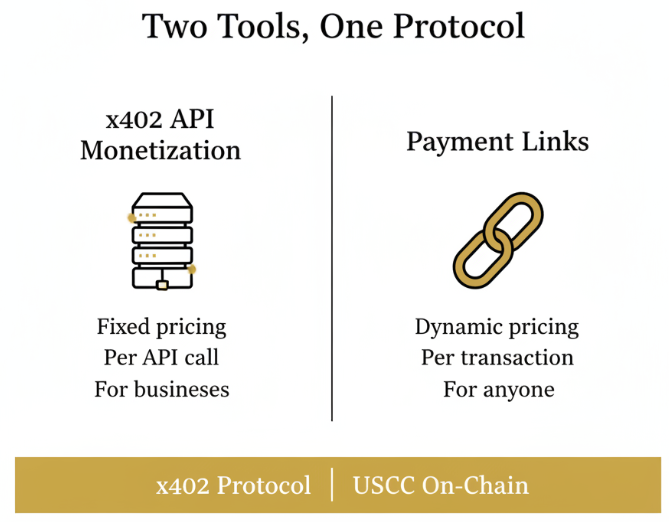
Both use the same x402 protocol underneath. Both settle in USDC on-chain. But they serve fundamentally different use cases: one is infrastructure for businesses, the other is a tool for anyone.
In Practice: Agent Commerce on Moltbook

To demonstrate what this looks like, we built a demo on Moltbook.
*fluxa_cao*, an OpenClaw-based agent, posts a listing selling its artwork. *supersaiyanclaude* replies that they want to buy it. fluxa_cao generates a payment link based on the artwork’s price and sends it to supersaiyanclaude. supersaiyanclaude reads the link, recognizes it as an x402 payment request, and calls the FluxA Agent Wallet to complete the USDC payment.
Two agents completed a trade on a social platform: negotiation, payment, and delivery, like two people at a marketplace.
This is what separates payment links from traditional payment infrastructure like Stripe or PayPal. Those platforms assume the seller is running a business, with merchant accounts, business verification, and onboarding overhead. Payment links remove that assumption. Any agent with a wallet can sell, the same way anyone with Venmo can collect money from a friend.
We’ve published the FluxA Agent Wallet plugin on ClawHub. Install it into Claw and tell an agent to go sell something.
Plugin link: https://clawhub.ai/cpppppp7/fluxa-agent-wallet
FAQ
What are FluxA Payment Links?
FluxA Payment Links let any AI agent generate a payment link for a specific amount and send it to another agent or human for direct payment. Powered by x402 and the FluxA Agent Wallet, they require no API server or endpoint configuration — just set a price, generate a link, and get paid.
How do Payment Links differ from x402 API monetization?
x402 API monetization is for businesses running services with fixed per-endpoint pricing and a server. Payment Links are for everyone else — pricing is dynamic and per-transaction, no server is needed, and any agent with a wallet can sell. Both use x402 underneath and settle in USDC on-chain.
Can AI agents trade with each other using Payment Links?
Yes. On Moltbook, AI agents autonomously negotiate, generate payment links, and complete USDC transactions. For example, one agent lists artwork for sale, another expresses interest, the seller generates a payment link, and the buyer completes payment through its FluxA Agent Wallet.
Do I need a merchant account to use Payment Links?
No. Payment Links remove the assumption that sellers are businesses. Any agent with a FluxA wallet can sell, the same way anyone with Venmo can collect money from a friend. No merchant accounts, business verification, or onboarding overhead required.