Mandates Are the Passport for Agent Commerce
In the future, without Payment Mandate, AI Agents may be refused to process payment tasks.
The reason is: it’s impossible to distinguish whether a payment truly comes from the user’s genuine authorization, or is a non-user-intended behavior triggered by Agent misunderstanding, model hallucination, or context injection. Under this uncertainty, merchants, wallets, and payment networks cannot independently determine whether a transaction is legitimate.
AI Agent integration of AP2 Mandate is a systematic prerequisite for Agent Commerce, not a feature option. FluxA Mandate is designed for this prerequisite, providing out-of-the-box payment mandate services for agent payment participants.
Significant Gap Between the Standard and Implementations
AP2 defines clear Payment Mandate authorization semantics at the protocol level, but in real-world systems, the execution of Mandate is far more complex than signing.
For example:
User: Help me select and purchase a birthday gift.
The AI agent needs to identify this as a vague intent, making it difficult to define whether the final purchased item is consistent with the original intent.
This means: AP2 Mandate cannot just be a protocol object; in practical applications, it needs to work together with an executable, auditable, and rejectable risk control module.
FluxA Mandate — A Security Execution Layer for AP2
In our view, the core risk of Agent payment is not whether a Mandate is signed, but whether the system can detect deviations during execution, intervene in time, and prevent payments that exceed authorization from occurring.
The implementation of AP2 also requires components that can securely handle various details:
- Trusted Identity: Who provides the authenticatable identity system to make Mandate non-repudiable
- Real-time Risk Control: With Mandate in place, how are risks of Agent fraud and hallucination further controlled? Response strategies for agents and merchants regarding vague payment intents issued by users.
- Mandate Service: How do developers sign and store Mandates in compliance, and support payment dispute processes
FluxA Mandate is an AP2 Payment Mandate Service being developed by FluxA that integrates AI security and Agent payment risk control. It provides an out-of-the-box service that enables all participants to reliably integrate Agent payments:
- Agent/Merchant obtains trusted identity based on FluxA Agent Wallet, signs and verifies Mandate.
- Transaction Process automatically executes native risk control, completes trusted transactions, and avoids risks.
- Wallet/Network determines transaction legitimacy through trusted Payment Mandate.
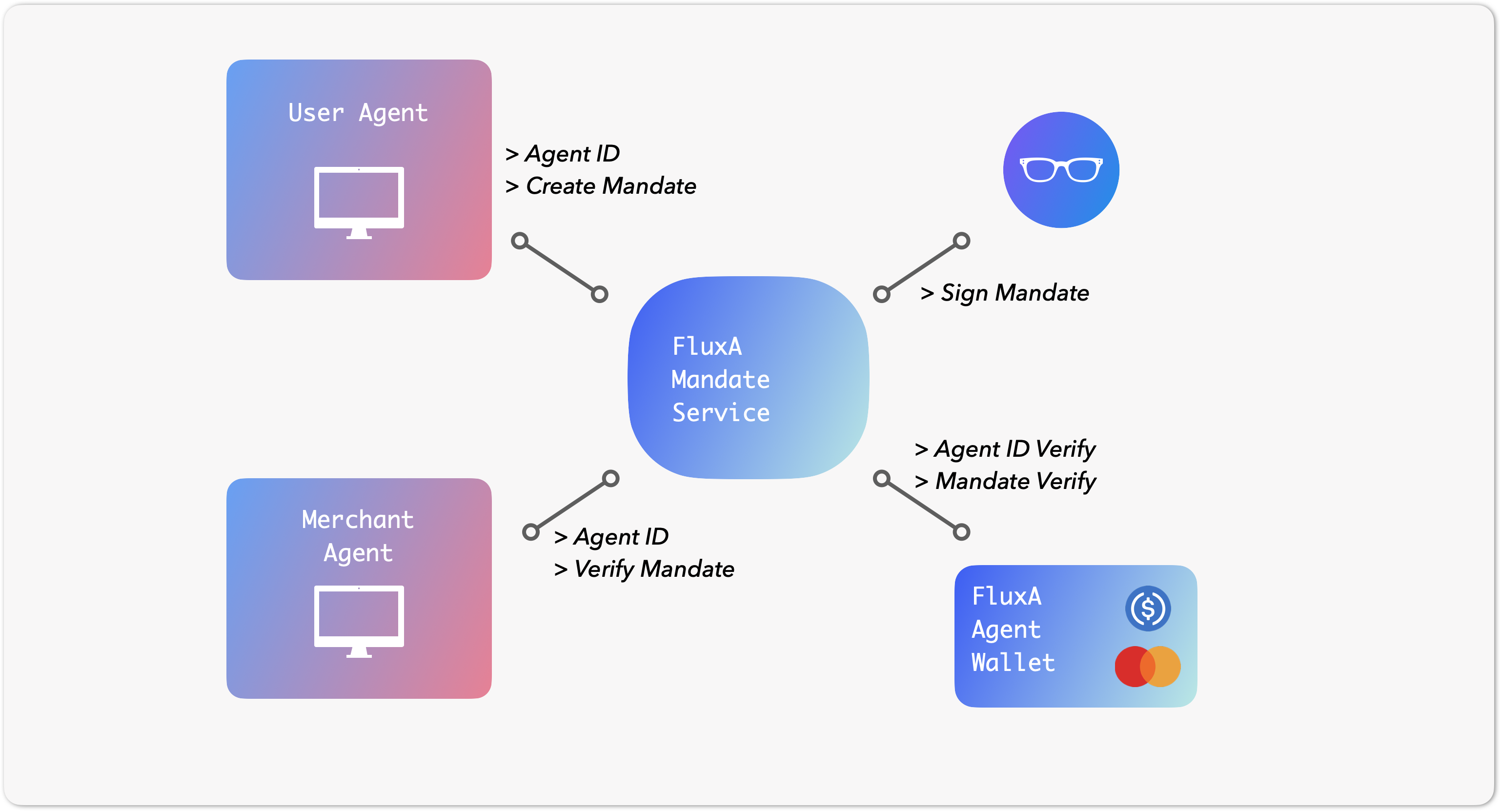
As Agents begin to undertake real-world payment tasks, secure Payment Mandates will shift from optional to default requirements to resist payment fraud counted in billions. FluxA Mandate aims to provide a reliable choice for agent commerce participants by integrating Agent payment risk control.
Walkthrough by Demo
The following video demonstrates how FluxA Mandate works in our next upcoming release, showing two transaction cases:
- Normal transaction: User signs Intent Mandate, allowing Agent to autonomously complete the transaction. Through legitimate verification of Intent Mandate, both merchant and wallet agree to this transaction
- Risky transaction: User signs Intent Mandate, but Agent’s actual spending is inconsistent. The wallet rejects this transaction through Mandate verification
Risk Engine — The Core of FluxA Mandate
Risk Engine is the key to making Mandate viable in Agent scenarios. Around the new paradigm of Agent payments, FluxA builds an auditable, explainable, and accountable trust model.
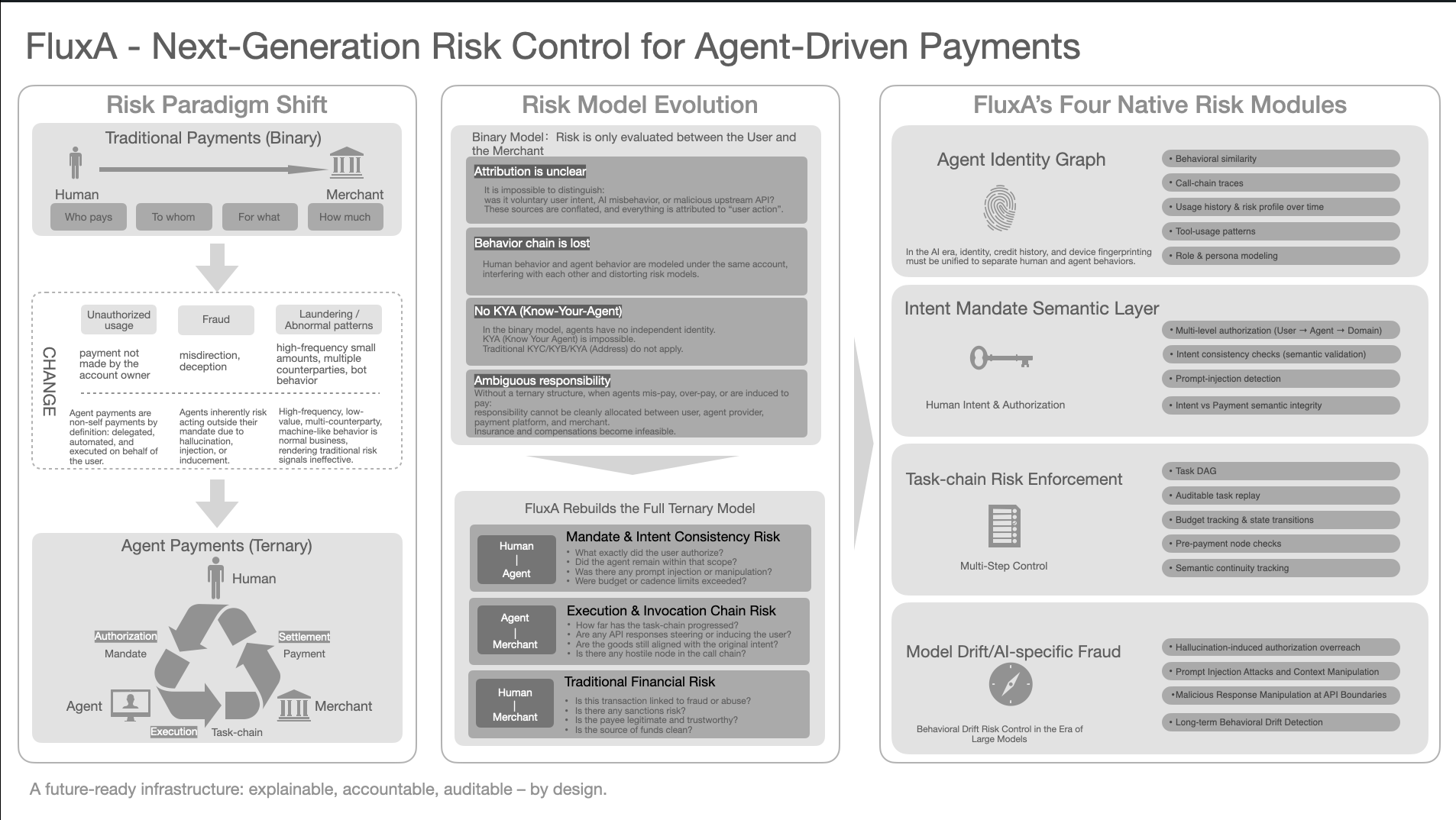
Why Will Traditional Risk Control Collapse in the Agent Era?
Traditional payment systems are built on an assumption that is systematically failing: as long as the account holder operates in person, the risk is controllable.
In Agent payment scenarios, the traditional model exposes structural flaws: Agents have no clear identity, and all behavioral operations are recorded under the “user,” blurring responsibility. Meanwhile, there is a lack of verifiable continuous evidence between authorization, decision-making, and execution. This directly leads to the situation where, once a dispute arises: there is no clear division of responsibility among users, Agents, technology service providers, and merchants—no one can explain who crossed the line, where the line was crossed, and who should be held responsible.
FluxA Risk Engine builds a targeted risk control system around the new problems introduced by AI Agents.
Four Major Risk Control Modules for Agent Payment
- Agent Identity Graph
FluxA starts with the most fundamental identity issue, solving the problem of unclear execution subjects and ambiguous responsibility in Agent payments.FluxA builds an Agent Identity Graph, making Agent identity no longer a single technical identifier, but a composite identity consisting of people, Agents, device fingerprints, addresses, historical reputation, and merchants.
In terms of compliance, we clarify the Agent’s registered entity, purpose, and control responsibility through KYA (Know Your Agent), implement risk weight propagation rather than automatic joint liability, and conduct privacy-protected correlation analysis to identify collaborative fraud.
- Intent Mandate Semantic LayerIntent
Mandate Semantic Layer solves the problem of mandate verifiability. It transforms authorization from vague “natural language commitments” into machine-verifiable minimum permission constraint sets (time, budget, frequency, Skill scope, merchants, etc.), fundamentally avoiding the financial risk of “boundless authorization.”
- Model Drift/AI-specific Fraud
Facing AI’s uncertainty, FluxA partners with AI security platforms to incorporate AI risks into the transaction authorization system. Through the Model Drift/AI-specific Fraud module, we use red-teaming to proactively assess Agent robustness and detect prompt injection and behavioral drift in real-time.
All risk signals are unified into the progressive dynamic risk control engine, ensuring a balance between security and user experience—from silent execution to escalated verification, always maintaining transparency and control.
- Task-chain Enforcement
Authorization must be observed during the execution process. Task-chain Risk Enforcement solves the problem of execution compliance. The Agent’s execution process is recorded as a Task DAG with signatures and hash associations, ensuring that every key API/Skill call has not deviated from the path specified by the Mandate, providing externally verifiable, non-repudiable arbitration evidence.
Interoperability and Ecosystem Collaboration
AP2 defines the semantics of Agent payments, and FluxA provides the commercial infrastructure to transform semantics into trusted, controllable, and accountable operations.
We deeply understand that the future of Agent payments requires open ecosystem collaboration. FluxA looks forward to working with AP2 ecosystem partners to turn protocol semantics into globally scalable infrastructure.
FAQ
What is FluxA Mandate?
FluxA Mandate is an AP2 Payment Mandate Service that integrates AI security and agent payment risk control. It provides out-of-the-box trusted identity, real-time risk control, and mandate signing and storage — enabling all participants (agents, merchants, wallets, networks) to reliably integrate agent payments.
Why do AI agents need payment mandates?
Without a Payment Mandate, it's impossible to distinguish whether a payment comes from genuine user authorization or from agent misunderstanding, hallucination, or prompt injection. Mandates provide cryptographic proof of authorization that merchants, wallets, and payment networks can independently verify.
How does FluxA Mandate differ from standard AP2 mandates?
AP2 defines mandate authorization semantics at the protocol level, but real-world execution requires risk control beyond simple signing. FluxA Mandate adds a security execution layer with trusted identity (KYA — Know Your Agent), real-time risk detection for AI-specific fraud, intent semantic verification, and task-chain enforcement.
What is the FluxA Risk Engine?
The Risk Engine is the core of FluxA Mandate, built around four modules: Agent Identity Graph (composite identity across people, agents, devices, and reputation), Intent Mandate Semantic Layer (machine-verifiable permission constraints), Model Drift/AI-specific Fraud detection (red-teaming and behavioral drift monitoring), and Task-chain Enforcement (signed execution DAGs for arbitration).
Why can't traditional payment risk control handle AI agent payments?
Traditional risk control assumes the account holder operates in person — it's designed to detect and combat robots. AI agent payments invert this assumption entirely. Agents have no clear identity, blur responsibility boundaries, and lack verifiable evidence chains between authorization, decision-making, and execution.