When an AI agent needs to pay for something, the temptation is to hand it a card number and move on. It's quick, it works — and it leaves your full credit line exposed to a piece of software that may interact with dozens of external services on your behalf. A shared card number doesn't expire when the task ends. It doesn't cap at the amount the job requires. And if it leaks, the damage is permanent until you cancel the card entirely.
AgentCard is built on a different premise: one task, one card, zero residual exposure.
TL;DR
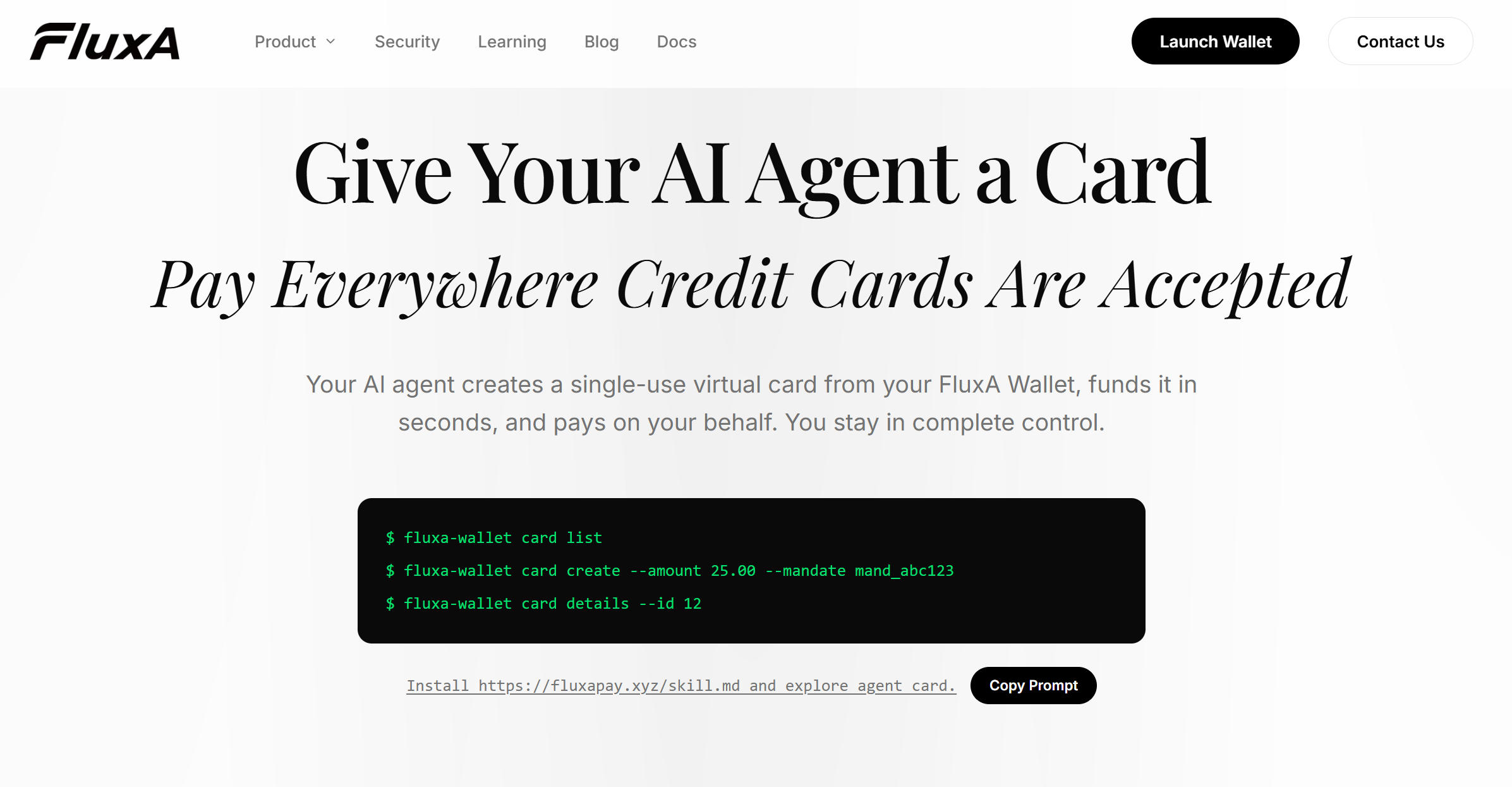
AgentCard is FluxA's disposable virtual card for AI agents. Each card is created on demand, locked to a specific amount, used once, and permanently closed the moment the transaction settles.
What makes it different:
- Provisioned instantly by the agent — no pre-registration, no approval queue
- Amount-locked per card, making overspending structurally impossible
- Single-use by design — card number is permanently invalid after settlement
- Unused balance returns to your FluxA Wallet automatically
- Every issuance, charge, and closure logged with agent identity and mandate context
What it replaces:
Any reusable credential — a real card number, a shared virtual card, or a billing-attached API key — that outlives the task it was created for.
Background: why a real card number is the wrong tool for an AI agent
Credit cards were designed around a human making a conscious purchase at a specific moment. AI agents work on a fundamentally different model: they execute tasks autonomously, interact with multiple external services in sequence, and may cache or transmit credentials in ways that are hard to track or audit.
Three structural problems emerge the moment you let an AI agent use a corporate credit card directly:
Full credit line exposed. The card gives access to far more than the task requires. A misconfigured workflow, a looping process, or a prompt injection attack doesn't cost you one transaction — it costs you whatever limit the card carries.
No selective revocation. There is no way to revoke access for just that agent, or just that task. Cancellation means cancelling the whole card — every subscription tied to it, every service using it, gone at once.
No isolated audit trail. Agent charges land in the same statement as personal spend. Tracing what the agent paid for, when, and why means manual reconciliation — assuming the records are granular enough to make that possible.
These aren't unlikely scenarios. They're the predictable outcome of using payment infrastructure that was never designed for autonomous software. AgentCard eliminates all three — not through better monitoring, but by making the risk structurally impossible from the moment the card is issued.
How AgentCard works
AgentCard follows a simple lifecycle: a card is created for a task, used once, and closed. Nothing carries over.
Step 1 — Create a card. The agent issues a single-use virtual card directly from your FluxA Wallet, with a specific amount attached. No pre-registration, no approval queue — the card exists the moment the task needs it.
Step 2 — Agent pays. The agent uses the card details to complete checkout for services, APIs, subscriptions, or any online purchase, all within the authorized amount. It works wherever credit cards are accepted online.
Step 3 — Card closes. Once the transaction settles, the card is automatically invalidated. The number is permanently dead. Any unused balance returns to your FluxA Wallet. One task, one card, nothing left behind.
What makes AgentCard different
On-demand provisioning.
Cards are generated on the fly, the moment a task requires payment. No setup, no waiting. The agent gets spending power exactly when it needs it and nowhere else.
Disposable by design.
Each card lives for exactly one job. Once payment settles, the card number is permanently invalid — credential leakage stops being a threat vector entirely.
Amount-locked authorization.
Every card is capped at the amount set for that specific task. Even a compromised agent cannot exceed it. The limit is enforced at issuance, not monitored after the fact.
Mandate-governed lifecycle.
Agent-issued cards inherit your agent wallet's mandate policies: spending caps, validity windows, and one-click revocation all apply automatically. No extra configuration needed.
Complete spend visibility.
Every card issuance, charge, and closure is recorded with the agent's identity and mandate context. The full history is accessible from your FluxA dashboard at any time.
AgentCard vs sharing your real card
| Real card | FluxA AgentCard | |
|---|---|---|
| Spending scope | Full credit line exposed | Amount-locked per card |
| Reuse risk | Card stays active forever | Single-use, auto-closes |
| Revocation | Cancel entire card | Close just that one card |
| Audit trail | Mixed with personal spend | Isolated per-agent log |
| Credential leak | Permanent damage | Card already expired |
The pattern is the same across every row: a real card treats the agent as a trusted human with open-ended access. AgentCard treats it as what it actually is — autonomous software that should operate within a tightly scoped credential that disappears the moment the job is done.
Before you deploy AgentCard
The disposable model eliminates the biggest structural risk upfront — credentials that outlive their purpose. A few additional considerations apply before going live.
What AgentCard handles by design:
- Credential leakage — once a card closes, the number is permanently invalid. Nothing to steal, rotate, or revoke after the fact
- Overspending — each card is locked to the amount set at issuance. An agent cannot charge beyond it, even if compromised
- Unauthorized reuse — single-use enforcement is structural, not policy-based. The card cannot be reused regardless of what the agent attempts
What still requires your attention:
- AgentCard works within your FluxA Wallet's mandate policies, so if you are still comparing agent wallets like FluxA, Skyfire, Coinbase, and Crossmint, settle the wallet layer first, then configure spending caps and validity windows before cards are issued
- An agent can issue multiple cards if no wallet-level spending limits are in place. Set those limits to cap total exposure across card issuances
- Regulatory compliance for high-value or cross-border transactions remains the wallet owner's responsibility
Conclusion
Most payment credentials are designed to persist — that's what makes them convenient for humans and dangerous for agents. A card number shared once stays valid indefinitely, attached to nothing, audited by no one.
AgentCard works the other way around. Every credential is born scoped, dies on schedule, and leaves a complete record behind. The agent operates freely within its task; you retain full visibility without managing anything manually.
If your agents interact with any paid service online, this is the lowest-friction way to give them payment capability without inheriting the risks that come with reusable credentials.
Get started with AgentCard — disposable virtual cards for AI agents, built into FluxA Wallet.
FAQ
What is an AgentCard?
A single-use virtual card issued by an AI agent from a FluxA Wallet. It is locked to a specific amount, used for one transaction, permanently invalidated after settlement, and any unused balance returns to the wallet automatically.
How is AgentCard different from a regular virtual card?
A regular virtual card stays active until cancelled — the credential persists across every task. AgentCard is disposable by design: one card per task, permanently closed after use, with no lingering credential to leak or misuse.
Can an agent issue multiple AgentCards?
Yes. Each card is independently scoped and closed after use. To cap total exposure across multiple issuances, configure wallet-level spending limits and validity windows in your FluxA Wallet settings.
What happens to unused funds on an AgentCard?
They return to your FluxA Wallet automatically. Nothing is lost when a task costs less than the card was issued for.
Is AgentCard safe if my agent gets compromised?
Yes — structurally. A compromised agent cannot spend beyond the amount locked at card issuance. Once the card closes, the number is permanently invalid. Wallet-level spending limits and one-click revocation provide additional layers of control.