What Is an AI Agent Wallet?
An AI agent wallet is a programmable financial account that lets autonomous AI agents hold, spend, and receive funds independently — within rules set by a human operator. The agent decides when to pay; the wallet enforces how much, to whom, and for how long.
The problem with legacy infrastructure is simple: Stripe charges $0.30 per transaction. The average agent payment in 2025 was $0.31. Traditional rails were not built for machines that transact at millisecond speed and cannot pass a CAPTCHA.
TL;DR
Three platforms define this space in 2026, though the six-platform comparison widens the field to Skyfire and Coinbase x402. Each solves a different part of the problem:
- Crossmint — full-stack agentic finance: agent wallets, virtual cards via Visa and Mastercard, stablecoin support across 40+ chains, and a World Store API with 1B+ real-world SKUs. Best for teams whose agents need to purchase goods in the real consumer economy.
- Nevermined — a billing and metering layer. Helps developers charge other agents for API and MCP tool access, with usage-based pricing and agent identity via DIDs. Best for monetizing services, not managing what your own agents spend.
- FluxA — an end-to-end payment layer built exclusively for agentic commerce. Combines a co-wallet for agent spending, virtual card issuance (AgentCard), MCP server monetization (FluxA Monetize), and the AEP2 protocol for embedding payment mandates inside x402, A2A, and MCP calls. Best for teams that need both sides of the equation — spending and earning — with human oversight at every layer.
Background: Constraints Every AI Wallet Must Navigate
Protocol support. The ecosystem has converged on three standards. Platforms that don't support all three create lock-in risk:
- x402 — HTTP-native payments developed by Coinbase, now backed by Cloudflare and Visa. Stripe integrated x402 on Base in February 2026.
- MCP — Anthropic's tool-connection standard. Downloads grew from 100K to 8M between November 2024 and April 2025.
- Google A2A — agent-to-agent authorization framework, backed by 60+ partners at launch.
Economics. USDC settlement on Base costs under $0.001 per transaction — the only viable rail for sub-dollar agent payments. All three platforms use it. The difference is what they build on top.
Security. Non-custodial architecture is table stakes. What separates these platforms is how they handle AI-specific risks: prompt injection attacks and LLM hallucinations that can cause an agent to spend in ways the user never intended. This is where the three platforms diverge most — covered in the comparison below.
Platform Deep Dives
Crossmint
What It Is
A full-stack agentic finance platform that enables AI agents to transact in the real consumer economy using both fiat card rails and stablecoins.
Key Features
- Agent wallets with programmable spending guardrails
- Virtual card issuance via Visa Intelligent Commerce and Mastercard Agent Pay
- World Store API: access to 1B+ real-world SKUs (Amazon, Shopify, flights, digital goods)
- Stablecoin support across 40+ chains
- Acts as Merchant of Record — handles returns, chargebacks, and PCI compliance
How to Use
- Create an agent wallet via the Crossmint API
- Fund the wallet via fiat or stablecoin onramp
- Call the checkout endpoint when the agent needs to purchase
- Crossmint handles credential storage, payment execution, and merchant integration
Pros
- Widest real-world purchasing coverage of any platform in this comparison
- Dual-rail (fiat card + stablecoin) in a single SDK
- No PCI handling required — Crossmint manages compliance
- Broad merchant compatibility including anti-bot bypass for automated purchases
Cons
- Agentic features are an extension of an NFT/Web2 product, not a ground-up agent design
- No native MCP server monetization — requires a separate billing layer
- No proprietary payment protocol; relies entirely on third-party standards
- No TEE security or AI-specific controls for hallucination and prompt injection risks
Best For Teams whose agents need to purchase physical or digital goods from real-world merchants, and where fiat card support is a hard requirement.
Nevermined
What It Is
A protocol-first billing and metering layer that helps developers charge other agents for API and MCP tool access — not a wallet for managing your own agents' spending.
Key Features
- Usage-based pricing: sub-cent micropayments starting at $0.001 per transaction
- Nevermined ID: cryptographically signed DID per agent, persistent across environments and marketplaces
- Native support for x402, MCP, A2A, and AP2 protocols
- Real-time metering and on-chain USDC settlement
- 1.38 million transactions processed since May 2025
How to Use
- Install the Nevermined SDK
- Wrap your MCP server or API endpoint with Nevermined's billing middleware
- Set per-call or per-interaction pricing
- Agents that call your server are automatically metered, identified, and billed
Pros
- Best-in-class metering for high-frequency, sub-cent transactions
- Persistent agent identity layer (DID) enables trust across multi-agent systems
- Deep multi-protocol support out of the box
- Proven at scale with production transaction volume
Cons
- Seller-side only — no consumer wallet, no virtual card, no spend controls for outbound agent payments
- Teams still need a separate wallet layer for their own agents' spending
- Not a standalone solution; designed as one component in a larger stack
- No hardware-level security or AI-specific fraud controls
Best For API providers and MCP server developers who want per-call revenue from other agents, and who already have or do not need a separate outbound wallet.
FluxA
What It Is
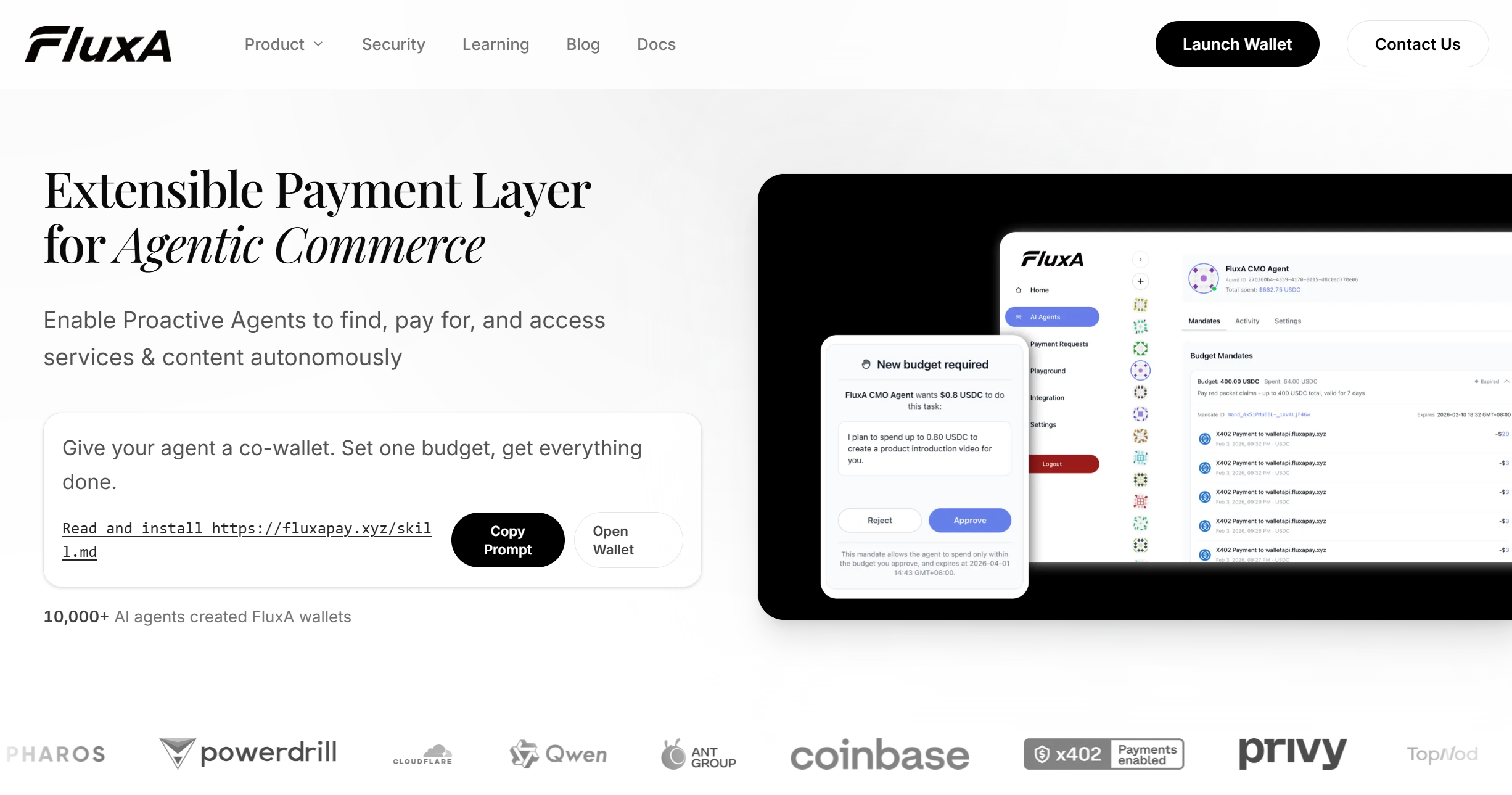
An end-to-end payment layer built exclusively for agentic commerce — the only platform in this comparison that covers both agent spending and agent earning within a single product.
Key Features
- FluxA AI Wallet — co-wallet with per-transaction limits, time-bound policies, host-scoped rules, one-click revocation, and automatic audit trails
- AgentCard — single-use virtual cards for agents, powered by x402 and Google AP2
- FluxA Monetize — MCP server and API monetization with per-tool-call pricing
- AEP2 Protocol — FluxA's embedded payment standard; improves on x402 with an authorize-first, settle-later model and ZK-SNARK batch verification for high-frequency micropayments
- TEE Hardware Security — every agent policy executes in a Trusted Execution Environment
- Real-time Risk Controls — detects and freezes spending caused by LLM hallucinations or prompt injection attacks
- Non-custodial architecture powered by Privy.io
- 10,000+ agent wallets live; partners include Coinbase, Cloudflare, Ant Group, Qwen, and MoonPay
How to Use
- Setting up a FluxA agent wallet is a short path: Open a wallet at agentwallet.fluxapay.xyz
- Set your agent's spending limits and authorization policy (one-time or long-term)
- Connect via the FluxA API or install the MCP skill at fluxapay.xyz/skill.md
- To monetize your own MCP server, connect it to monetize.fluxapay.xyz and configure per-tool pricing
Pros
- Only platform combining outbound spending (wallet + card) and inbound monetization (MCP) in one product
- AEP2's authorize-first model eliminates the latency of standard x402 pay-first flows
- TEE isolation and hallucination protection address the AI-specific threat model that standard wallets ignore
- Granular human oversight without workflow friction
- Purpose-built for agents: not adapted from NFT, Web2, or SaaS infrastructure
Cons
- No real-world consumer commerce (no equivalent of Crossmint's World Store)
- Primarily USDC on Base; multi-chain expansion ongoing
- Younger platform; merchant and ecosystem breadth still growing
Best For Teams building AI-native infrastructure that need agents to both spend autonomously and monetize their own capabilities — with enterprise-grade security and full human oversight on every transaction.
Comparison Table
| Crossmint | Nevermined | FluxA | |
|---|---|---|---|
| Agent wallet | ✓ | Limited | ✓ |
| Virtual card issuance | ✓ Visa / Mastercard | ✗ | ✓ AgentCard |
| Real-world commerce | ✓ 1B+ SKUs | ✗ | ✗ |
| MCP monetization | ✗ | ✓ | ✓ |
| x402 support | ✓ | ✓ | ✓ Native |
| A2A / Google AP2 | Partial | ✓ | ✓ Native |
| Proprietary protocol | ✗ | ✗ | ✓ AEP2 |
| Authorize-first settlement | ✗ | ✗ | ✓ |
| Spend limits + revocation | ✓ | ✗ | ✓ |
| TEE hardware security | ✗ | ✗ | ✓ |
| LLM hallucination protection | ✗ | ✗ | ✓ |
| Non-custodial | ✓ | ✓ | ✓ Privy |
| Built exclusively for agents | ✗ | ✗ | ✓ |
Crossmint is the right fit if your agents need to purchase physical or digital goods from real-world merchants — it is the only platform here with card network support and a billion-SKU commerce layer.
Nevermined serves a different audience entirely: developers monetizing their own services, not managing outbound agent spending. Both platforms are strong in their lane, but neither covers the full payment lifecycle of an AI agent.
FluxA is the natural choice for teams that need both sides of that equation — agents that spend and earn, secured by hardware-level isolation and real-time AI risk controls that the other two platforms simply do not offer. If you are building production-grade agentic infrastructure in 2026, start with the FluxA wallet or read the docs to see where it fits your stack.
Compliance, Ethics, and Responsible Use
AI agent payments operate at the intersection of autonomous systems and real financial infrastructure. A few guardrails apply across all three platforms reviewed here.
What you can do:
- Deploy agents that transact autonomously within pre-authorized budgets and time-bound policies
- Settle payments in USDC on Base or other supported chains without a money transmitter license (infrastructure-layer usage)
- Monetize MCP servers and APIs on a per-call basis using x402 or AEP2
What to be aware of:
- Agents acting as payment initiators on behalf of users may trigger KYB/KYC requirements at scale — all three platforms support verification flows, but operators are responsible for compliance in their jurisdiction
- The EU AI Act (in force August 2024, progressively applied through 2027) requires auditable records for automated decision-making that affects financial transactions — FluxA's automatic audit trail on every payment is directly relevant here
- Never deploy agents with uncapped spending authority; spending limits and revocation controls are not optional features — they are the minimum responsible configuration for any production agent
Conclusion
For most teams building in 2026, the right AI agent wallet comes down to one question: what does your agent actually need to do?
Crossmint serves teams that need agents to purchase in the fiat consumer economy. Nevermined serves developers monetizing their own services. FluxA is for teams that need the full picture — agents that spend and earn, protected by hardware-level security and governed by human-defined rules. It is the only platform in this comparison built exclusively for agentic commerce, not adapted from an existing product.
FAQ
Is an AI agent wallet the same as a crypto wallet?
No. A crypto wallet gives full access to whoever holds the key. An AI agent wallet adds programmable guardrails — spending limits, time windows, and revocation controls — so an agent can transact autonomously without unlimited access to your funds.
Which platform is best for MCP server monetization?
Both Nevermined and FluxA support MCP monetization. FluxA is the stronger choice for teams that also need an outbound spending wallet, as it handles both sides within one product.
Do I need a crypto background to use FluxA?
No. FluxA is designed for AI developers, not Web3 specialists. The wallet setup takes minutes, and agents connect via a standard API or by installing the MCP skill — no blockchain expertise required.
Is FluxA custodial?
No. FluxA uses Privy's non-custodial infrastructure. You — not FluxA — control your wallet keys at all times. FluxA provides software infrastructure only and does not hold or custody customer funds.
What happens if my agent gets compromised or hallucinates a payment?
FluxA's real-time risk controls detect unusual spending patterns — including those caused by LLM hallucinations or prompt injection — and can automatically freeze suspicious activity. Spending limits cap the maximum exposure even before controls trigger.
What is AEP2 and how is it different from x402?
AEP2 is FluxA's embedded payment protocol. Unlike x402's pay-first model, AEP2 uses authorize-first, settle-later — the agent embeds a signed mandate into the request, enabling instant verification and deferred on-chain settlement without blocking the workflow.
Can I use FluxA to both spend and earn as an agent operator?
Yes. FluxA is the only platform in this comparison that covers both. Use the FluxA AI Wallet and AgentCard for outbound payments, and FluxA Monetize to charge other agents for accessing your MCP servers or APIs.