When developers first need their AI agent to access a paid service, the default move is an API key. It takes thirty seconds, works immediately, and feels contained. The problem surfaces later — when the key is still active months after the task ended, when there's no record of what the agent charged, or when you realize it grants far more access than the agent ever needed.
An AI agent wallet approaches the same problem from a different angle. The question isn't just "how does the agent authenticate?" — it's "how does the agent transact, within boundaries, with a full record of every financial action?"
TL;DR
An API key and an AI agent wallet both let an agent access external services — but they solve fundamentally different problems.
What an API key gives you:
- Fast authentication with a third-party service
- All-or-nothing access until manually revoked
- No spending controls, no audit trail, no scoped limits
What an AI agent wallet gives you:
- Autonomous payment capability with defined spending policies
- Per-transaction limits, validity windows, and instant revocation
- A complete audit trail of every action the agent takes with money
The core difference: An API key is an access credential. An agent wallet is a financial control layer. For agents that only read data, a key may be sufficient. For agents that spend money, a wallet is the right infrastructure.
Why API keys break down when money is involved
API keys were built for one job: prove to a server that a request comes from an authorized source. For read-only access, that's enough. The moment an agent starts triggering charges — paying per call, per query, per output — the model stops holding up.
Three specific points where it breaks:
1. Access has no boundaries. There's no way to say "this agent can spend up to $20 per day" or "this key expires in 48 hours." Share a key, and the agent has full access to whatever it permits — indefinitely, with no scope, no ceiling, and no expiry.
2. Revoking it is disruptive. Killing an API key typically means logging into a dashboard, generating a replacement, updating your codebase, and redeploying. For a production agent running across multiple services, that sequence is slow, manual, and fragile.
3. It leaves no financial record. API logs track requests — not spending intent. They record that a call was made, not why, not by which agent, not as part of which task. Reconciling what an agent actually spent against what it was authorized to spend requires piecing together data from multiple disconnected sources.
An AI agent wallet replaces this model with controls designed for financial authorization from the start: per-transaction limits, time-bound policies, instant revocation, and automatic audit trails — without touching your codebase. See how FluxA AI Wallet works →
API key vs AI agent wallet: a direct comparison
The difference isn't just technical — it's architectural. One was built for authentication, the other for financial delegation.
| API Key | FluxA AI Wallet | |
|---|---|---|
| Primary purpose | Service authentication | Autonomous payment + access control |
| Spending limits | None | Per-transaction + policy-based |
| Access scope | All-or-nothing | Scoped by host, amount, time window |
| Revocation | Requires code change | One-click, instant effect |
| Audit trail | Request logs only | Full financial trail with agent identity |
| Risk controls | None | Built-in, real-time |
| Multi-agent support | Manual key management | Native, per-agent policies |
| Credential expiry | Manual only | Automatic via validity windows |
The gap widens as agent complexity grows. A single agent calling one API is manageable with a key. Ten agents, each interacting with multiple paid services, each needing different spending limits and different revocation timelines — that's where the absence of a financial control layer becomes a real operational problem.
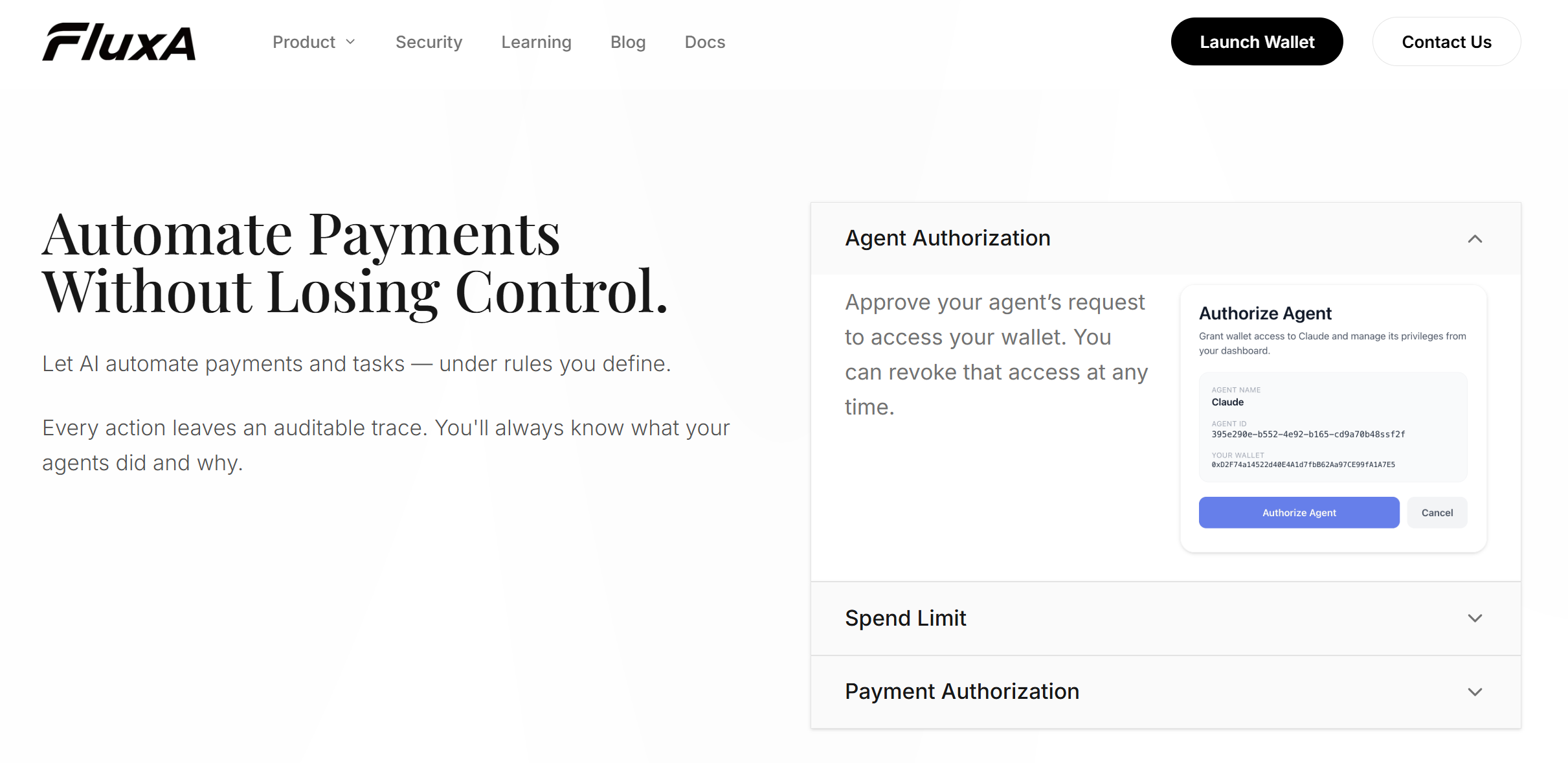
How FluxA AI Wallet works in practice
FluxA replaces the API key model with a mandate-based system — you define what the agent is allowed to do financially, and the infrastructure enforces it.
Step 1 — Establish agent identity.
The agent receives a FluxA-issued Agent ID, giving it verified access to your wallet and any service that supports FluxA Agent ID authentication.
Step 2 — Define a spending mandate.
Set a budget, choose an authorization mode — per-transaction approval via Google AP2, or long-term pre-authorization scoped by host and validity window — and the agent operates within those boundaries automatically.
Step 3 — Agent transacts autonomously.
Within the mandate, the agent pays via x402 protocol, issues single-use AgentCards for individual purchases, or sends USDC payouts to any wallet address — without interrupting you.
Step 4 — Everything is logged.
Every payment is recorded automatically with agent identity, mandate context, amount, and timestamp. The full audit trail is available from your dashboard at any time.
What stays the same as an API key: the agent still authenticates with external services and calls paid APIs without human intervention on every request.
What changes: the financial layer now has structure — boundaries that hold, a record that exists, and a kill switch that works in one click.
When an API key is still the right choice
An agent wallet isn't the right tool for every scenario. API keys remain the appropriate choice when:
- The agent accesses read-only services with no billing attached
- You're in early prototyping and no real funds are involved
- The service doesn't support wallet-based payment flows and charges are negligible
- You need a quick integration for a short-lived, low-stakes task
The threshold is straightforward: as soon as an agent has the ability to trigger charges — however small — the case for a financial control layer begins. The cost of setting one up is low; the cost of not having one when something goes wrong is not.
Securing agent payment access
API keys and agent wallets carry different risk profiles. The gap between them widens as soon as real money is involved.
A leaked API key remains valid until someone notices and rotates it manually — typically requiring a code change and redeployment. That window between the leak and the fix is where damage accumulates. FluxA addresses this differently: agent policies execute inside a TEE (Trusted Execution Environment) that isolates policy logic from tampering, the base wallet layer is non-custodial via Privy, and revocation is one click with instant effect — no code changes, no redeployment.
Prompt injection is a shared risk that neither approach fully eliminates. Malicious instructions embedded in external content can redirect an agent's actions regardless of what payment infrastructure sits underneath. Spending limits reduce the blast radius — they don't neutralize the underlying threat. Input validation, output filtering, and allowlisted recipient addresses all matter alongside whatever financial layer you deploy.
The practical checklist before going live:
- Scope every credential to the minimum access the agent actually needs
- Test revocation before deploying — know exactly how fast it works and what it affects
- Confirm your audit trail captures agent identity, amount, and context for each transaction
- Set spending limits before the agent touches real funds, not after the first unexpected charge
Conclusion
API keys solve an authentication problem. They were never designed to govern how autonomous software spends money — and that absence of structure becomes visible the first time something goes wrong.
An AI agent wallet doesn't replace API keys. It adds the layer that was always missing: financial boundaries that hold, credentials scoped to what the agent actually needs, and a record that doesn't require manual reconstruction after the fact.
For any agent with real payment capability, the question isn't whether to add a financial control layer. It's how long you're comfortable operating without one.
See how FluxA AI Wallet handles agent payment authorization →
FAQ
Is an AI agent wallet the same as an API key?
No. An API key handles service authentication — it proves the request came from an authorized source. An agent wallet handles financial authorization — it defines what the agent can spend, on what, and for how long. Most production setups need both.
Are API keys safe to use with AI agents?
For read-only access with no billing attached, yes. Once an agent can trigger charges, an API key provides no spending boundaries, no scoped expiry, and no financial audit trail. The risk compounds quietly until something goes wrong.
What happens if an AI agent's API key is stolen?
The key stays valid until manually rotated — typically requiring a code change and redeployment. Any charges made before revocation cannot be reversed. With FluxA AgentCards, the card number is permanently invalid after one use, leaving nothing to exploit.
Can an AI agent have both an API key and a wallet?
Yes — and that's the recommended setup for most production agents. The API key handles authentication with third-party services. The wallet governs the financial layer: spending mandates, transaction limits, audit trails, and revocation. They operate in parallel, not in competition.
How do I know what my AI agent spent?
With an API key alone, you don't — at least not without manual reconciliation across service dashboards. FluxA logs every transaction automatically with agent identity, mandate context, amount, and timestamp. The full trail is available from your dashboard at any time.