You Built Something Valuable. You're Not Getting Paid for It.
Over 11,000 MCP servers are indexed across public registries today. Fewer than 5% charge for access.
That gap isn't a coincidence — it's an infrastructure problem. The Model Context Protocol defines a clean, standardized interface between AI agents and external tools. What it does not define is how payment flows across that interface. Billing, access control, and settlement are left entirely to the developer.
So most developers fall back on what they know: free tiers, API keys, or a manual Stripe integration bolted on after the fact. Each of these creates friction that doesn't belong in an autonomous agent workflow — and often, developers just skip monetization entirely.
This article breaks down three practical approaches to charging for MCP server usage, when each makes sense, and why the architecture of your payment layer matters as much as the tools you expose.
TL;DR
| Approach | Setup | Agent-Native | Scales |
|---|---|---|---|
| Manual billing (API keys + subscriptions) | Low | ✗ | ✗ |
| FluxA Monetize | Low | ✓ | ✓ |
| Third-party metered billing (e.g. Stripe metered) | High | ✗ | Partial |
If your MCP server is being called by AI agents — not humans clicking buttons — you need a payment layer that agents can interact with autonomously. Manual billing breaks that loop. FluxA is built to close it.
Background: Why Standard Billing Doesn't Work for MCP
MCP interactions are structurally different from how traditional APIs get consumed. A single agent prompt can chain dozens of tool calls in rapid succession, with no human approving each one. This breaks two core assumptions that most billing infrastructure is built on:
Assumption 1: A human initiates and reviews each transaction.
Subscription models, checkout pages, and invoice flows all require a person at some point in the loop. When the caller is an autonomous agent running inside a pipeline, that person isn't there.
Assumption 2: Usage is predictable and human-paced.
Per-seat pricing and flat monthly fees made sense when software was used by people during working hours. Agent-driven usage is spiky, high-frequency, and non-linear. A single workflow can generate hundreds of tool invocations before you've had your morning coffee.
The third problem is discovery. When you publish an MCP server with no machine-readable pricing attached, agents have no way to evaluate cost before invoking your tools. There is no quote step, no budget check, no receipt — just unbounded consumption until something breaks or someone notices.
The result: most MCP servers either stay free by default, or developers spend weeks building custom billing middleware that was never designed for this protocol.
How to Monetize Your MCP Server: 3 Approaches
Method 1: Manual Billing — API Keys + Subscriptions
The instinctive first move. You generate API keys, set up a Stripe subscription page, and ask users to bring their own key when connecting to your server. It works for human users who sign up, read documentation, and manage their own access.
It breaks for agents.
How it works:
Issue API keys per user. Gate tool access server-side by validating the key on each request. Separately manage billing through a subscription platform or manual invoicing.
Pros:
- No additional infrastructure
- Familiar setup for any developer who has built a SaaS product before
- Works fine when your primary users are humans
Cons:
- Agents cannot self-provision API keys — a human must still complete the signup flow
- Flat subscriptions don't reflect actual tool usage; a power user and a light user pay identically
- No per-tool pricing granularity — you charge for access, not for value delivered
- Manual invoicing doesn't scale past a handful of customers
- Zero machine-readable pricing — agents can't evaluate cost before invoking your tools
Best for: Early-stage servers where all users are developers signing up manually, and call volume is low enough to manage by hand.
As soon as agent traffic becomes a meaningful share of your usage, manual billing creates a structural mismatch between how your server gets used and how you get paid.
Method 2: FluxA Monetize — Agent-Native Billing Infrastructure
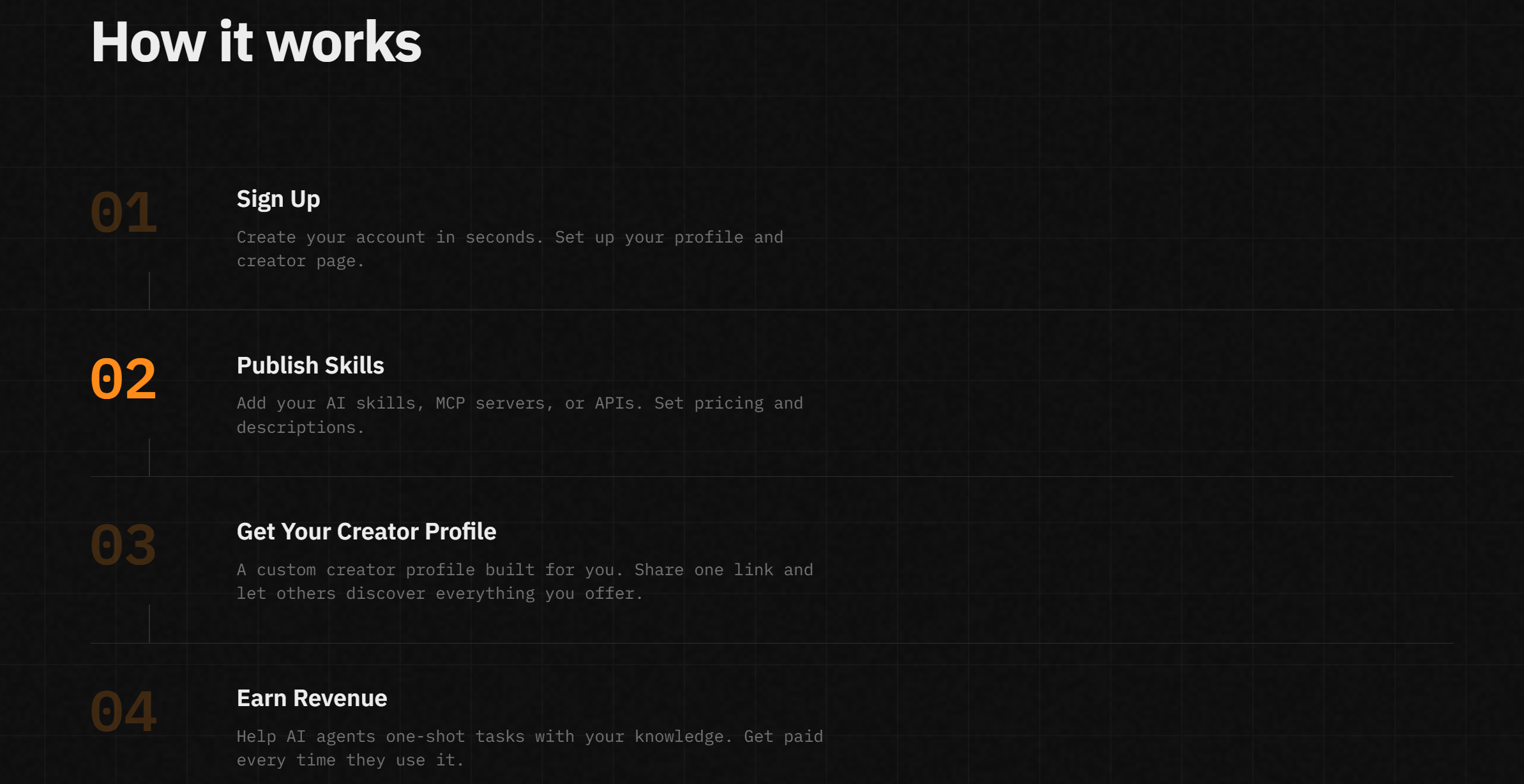
FluxA Monetize is purpose-built for exactly this scenario. Instead of retrofitting human billing flows onto agent traffic, it embeds payment directly into the MCP tool invocation cycle — so agents can autonomously discover pricing, pay per call, and generate a receipt, with no human in the loop.
Key features:
- Granular tool pricing — set individual prices per tool, not per server
- Automatic usage tracking — every invocation is metered and logged
- Transparent billing — pricing is machine-readable upfront; agents know the cost before they call
- Zero payment dev work — no Stripe integration, no webhook logic, no invoice management
- Stablecoin settlement — zero-fee USDC payments via x402 protocol
- Marketplace distribution — your server is discoverable without additional publishing effort
Pros:
- Designed for agent-to-tool payment flows from the ground up
- Per-tool granularity aligns revenue with the actual value each tool delivers
- Agents can self-onboard — no human signup friction in the caller's workflow
- Works across all major MCP-compatible clients out of the box
Cons:
- Best suited for USDC settlement; fiat payout rails are still maturing
- Requires registering your server on the FluxA platform
Best for: Any MCP server with meaningful agent traffic — from indie developers monetizing a side project to teams running production-grade tool infrastructure at scale.
Method 3: Third-Party Metered Billing — Stripe, Moesif, AWS API Gateway
For developers who need fiat billing, custom pricing logic, or enterprise contract support, third-party metered billing platforms offer a more flexible — but significantly more complex — path.
Stripe Metered Billing, Moesif, and AWS API Gateway usage plans all let you charge per API call with granular reporting. The tradeoff is that none of them were designed for MCP, which means you're responsible for bridging the gap yourself.
How it works: Instrument your MCP server with usage reporting middleware. Push invocation events to your billing platform on each tool call. Manage customer provisioning, key issuance, and plan enforcement separately.
Pros:
- Supports fiat billing and traditional enterprise payment flows
- Deep reporting and quota management capabilities
- Integrates with existing finance and revenue operations tooling
Cons:
- No native MCP protocol awareness — all instrumentation is custom-built
- Agents still cannot self-onboard; human signup is required upstream
- No machine-readable pricing for agent consumption
- Significant engineering overhead: middleware, webhooks, customer portal, dunning logic
- Ongoing maintenance burden as MCP protocol evolves
Best for: Enterprise deployments where customers require fiat invoicing, existing Stripe contracts, or compliance with procurement processes that don't accept stablecoin settlement.
Method Comparison
| Manual Billing | FluxA Monetize | Third-Party Metered | |
|---|---|---|---|
| Setup complexity | Low | Low | High |
| Per-tool pricing | ✗ | ✓ | Partial |
| Agent self-onboarding | ✗ | ✓ | ✗ |
| Machine-readable pricing | ✗ | ✓ | ✗ |
| Auto Quote-Pay-Receipt | ✗ | ✓ | ✗ |
| Usage audit trail | ✗ Manual | ✓ Automatic | ✓ Custom |
| Fiat billing support | ✓ | Maturing | ✓ |
| Scales to agent traffic | ✗ | ✓ | Partial |
Manual billing handles human signups but has no answer for autonomous agent callers. Third-party metered platforms give you powerful reporting and fiat support, but require substantial custom engineering to work with MCP — and still don't solve the agent self-onboarding problem. FluxA is the only approach here where the entire cycle — discovery, pricing, payment, receipt — is native to how agents actually invoke tools.
If your server is getting called by agents today without any billing attached, you are already leaving money on the table. The infrastructure to fix that now takes four steps, not four weeks.
Agent Payment Security & Compliance
Monetizing an MCP server introduces a distinct set of risks that standard API security practices don't fully cover. Before exposing paid tools to agent traffic, address these three failure modes:
| Risk | What Goes Wrong | Mitigation |
|---|---|---|
| Unbounded invocation | An agent loops or misbehaves, triggering hundreds of paid tool calls before anyone notices | Per-session spend caps enforced at the payment layer, not the application layer |
| Unauthorized access | Stolen or leaked credentials grant full tool access with no usage ceiling | Short-lived, scoped authorization tokens — not static API keys |
| No audit trail | Tool calls are metered but not attributed — you can't tell which agent, workflow, or user drove a charge | Agent-identity-tagged invocation logs tied to every transaction |
Core principle:
Billing infrastructure that only tracks what was charged — without recording who called what and why — is not sufficient for production-grade agent deployments.
FluxA Monetize addresses all three vectors: usage is metered per tool invocation, every transaction is logged against a verified agent identity, and spend visibility is available to both the server operator and the calling agent's owner.
Conclusion
The MCP ecosystem is growing fast — but fewer than 5% of servers currently charge for access. That gap exists because the payment infrastructure to close it simply wasn't available until recently.
The three approaches in this article each solve a different slice of the problem:
- Manual billing works for human signups at low volume — it has no native answer for autonomous agent callers
- Third-party metered billing gives you fiat support and reporting power, but requires significant custom engineering and still doesn't solve agent self-onboarding
- FluxA Monetize is the only approach where pricing, payment, and receipts are native to the agent invocation cycle — four steps to set up, zero billing code to maintain
If your MCP server is being called by agents today with no billing attached, the fix is simpler than you think.
Turn your tools into a revenue stream — without writing a single line of billing code.
Frequently Asked Questions
How do I add payments to an existing MCP server?
Register your server URL on FluxA Monetize, configure per-tool pricing, and publish. FluxA reads your tool manifest automatically — no changes to your server code are required. The entire setup takes under 15 minutes.
What is the minimum price I can charge per tool call?
The minimum is $0.01 per invocation. You set individual prices per tool, so compute-heavy tools and lightweight lookups can be priced independently to reflect actual cost and value.
Do AI agents need a human to complete the payment flow?
Not with agent-native infrastructure. FluxA Monetize supports autonomous Quote-Pay-Receipt cycles — the agent discovers pricing, pays per invocation, and receives a receipt without any human interaction required at checkout.
Can I charge different prices for different tools on the same server?
Yes. FluxA Monetize supports granular per-tool pricing within a single server. Each tool in your manifest gets its own price configuration, giving you full control over how you monetize different capabilities.
What happens if an agent calls my tools without sufficient balance?
The invocation is declined before execution. The agent receives a structured payment-required response it can handle programmatically — either by requesting a top-up from its human owner or surfacing the constraint upstream in the workflow.
Is FluxA Monetize compatible with Claude, Cursor, and other MCP clients?
Yes. FluxA-monetized servers are compatible with any MCP-capable client, including Claude Desktop, Claude Code, Qwen Code, Cursor, and Windsurf. No client-side changes are needed.
How does settlement work — when and how do I get paid?
Payments settle in USDC via the x402 protocol. Funds are tracked per invocation in your FluxA dashboard. Withdrawal options and payout schedules are managed directly through your account settings.