Key Takeaways
- x402 (Coinbase): Embeds stablecoin payments into HTTP — agents pay per request with no account signup or redirects required.
- ACP (OpenAI + Stripe): Standardizes agent-to-merchant checkout via four RESTful endpoints and single-use payment tokens.
- AP2 (Google + 60+ partners): An authorization framework, not a payment rail — cryptographically signed mandates prove an agent has permission to spend.
- MPP (Stripe + Tempo): Pre-authorizes a spending session upfront, then streams micropayments across stablecoin, fiat, and Lightning rails without per-request on-chain settlement.
Introduction
AI agents can browse, code, and coordinate autonomously. Paying for things cleanly is the gap that remains.
Four protocols arrived in quick succession to close it: x402, ACP, AP2, and MPP — each backed by a major tech company, each solving a different layer of the problem. Most coverage frames them as rivals. They aren't. They occupy distinct positions in the same stack, and most production deployments will need more than one. Protocols are only one slice of how an agent payment system is architected end to end, which also spans identity, wallets, and risk control, but they are where the design choices begin.
This guide defines each protocol precisely, compares them on the dimensions builders actually care about, and offers a clear framework for choosing what belongs in your agent architecture.
What Is x402?
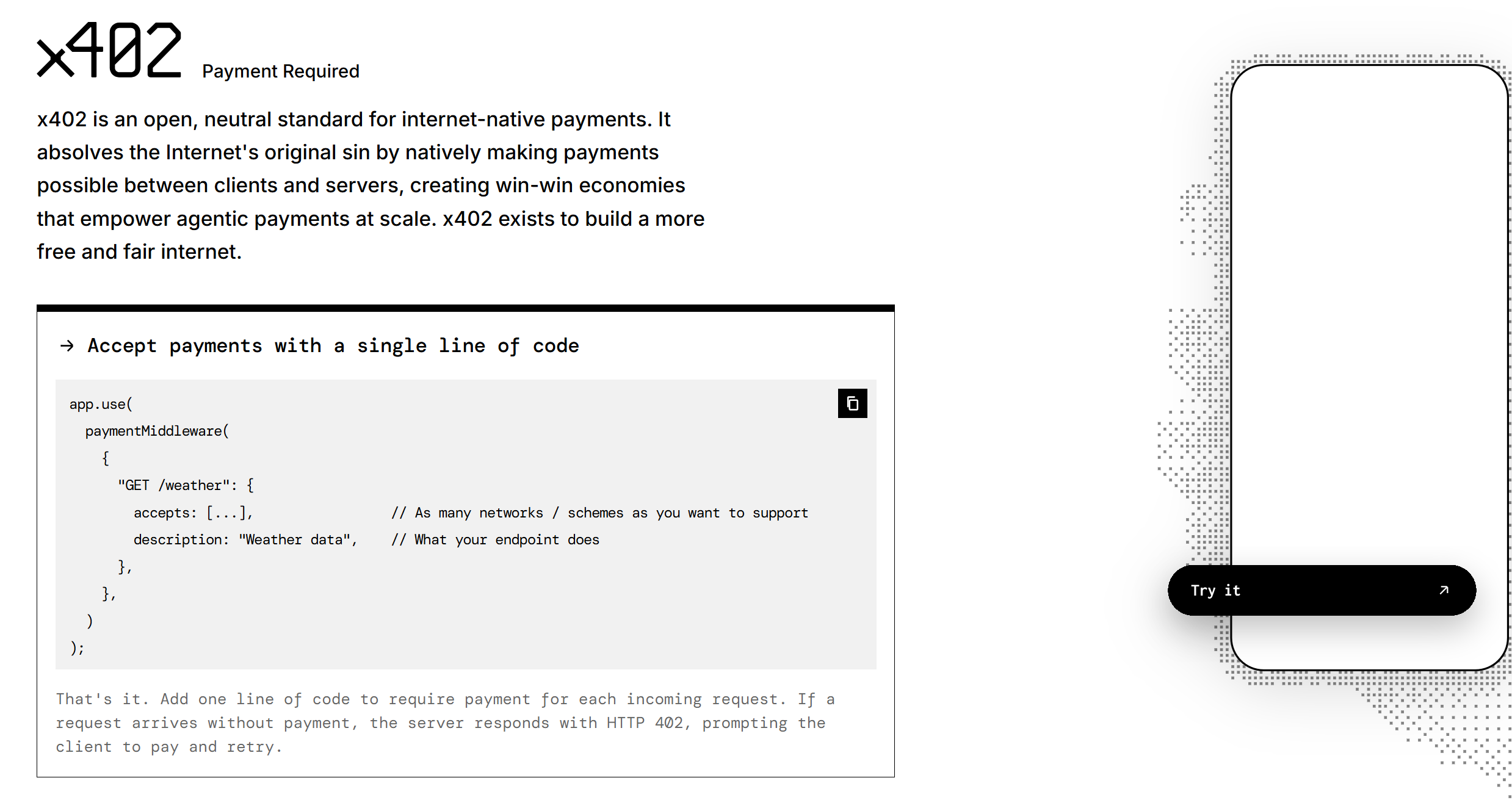
x402is Coinbase's HTTP-native payment protocol — agents pay per request in stablecoins, with no account signup or redirects required.
A client requests a resource. The server returns HTTP 402 with price and wallet details. The client signs a USDC payment, attaches it to the request header, and receives the resource, all within a single HTTP cycle. That one exchange is how x402 turns a plain HTTP request into a payment rail, and the full breakdown covers the 402 response fields and the facilitator step this summary skips.
Coinbase launched x402 in May 2025; V2 (December 11, 2025) added wallet-based sessions, multi-chain support, and a fully modular SDK; Stripe integrated x402 on Base in February 2026; the x402 Foundation — stewarded by the Linux Foundation, with Coinbase, Cloudflare, Stripe, Google, and Visa among its founding members — launched on April 2, 2026. The protocol processed over 100 million transactions within its first six months.
Best for: Pay-per-request API monetization, M2M data feeds, agent-to-agent service calls.
Key limitation: Primarily stablecoin-based; each request settles independently, so very high call volumes accumulate costs without session-level batching.
What Is ACP?
ACPis OpenAI and Stripe's open checkout protocol — it gives agents a structured way to complete purchases through merchant checkout flows.
Four RESTful endpoints cover the full lifecycle: Create → Update → Complete → Cancel. Payment flows via a SharedPaymentToken (SPT): single-use, time-bound, and amount-locked, so agents transact on a user's behalf without accessing raw card credentials.
ACP launched as an open standard on September 29, 2025, the same day as OpenAI's Instant Checkout — its first production deployment, initially with Etsy and Shopify merchants. OpenAI shut down Instant Checkout in early March 2026 after conversion rates fell short; only around 12 merchants ever went live, and users tended to complete purchases on familiar retail sites where they had saved accounts. The ACP protocol itself remains active, with Shopify, Salesforce, and PayPal continuing to build on it.
Best for: Conversational retail commerce where a human principal sits behind every purchase.
Key limitation: Currently fiat-only via Stripe SPT (the protocol itself is payment-method-agnostic); built for human-present checkout flows, not M2M micropayments or autonomous stablecoin settlement. The Instant Checkout shutdown also signals that consumer trust in agent-led purchasing is still early.
What Is AP2?
AP2is Google's open authorization framework — it proves an agent is permitted to spend before any money moves.
Its core primitive is the Mandate: a cryptographically signed (e.g., ECDSA) W3C Verifiable Credential that captures what an agent can buy, for how much, and under what conditions. Three types cover the full range: Intent Mandate (authorizes an agent to act in human-not-present scenarios, within pre-set rules); Cart Mandate (used in human-present scenarios, where a user approves a specific cart before checkout); Payment Mandate (signals agent involvement to payment networks and issuers for risk and compliance assessment). AP2 extends both Google's A2A protocol and MCP; its A2A x402 extension handles stablecoin settlement when needed. Partners include Mastercard, Visa, Adyen, Coinbase, PayPal, and more than 60 organizations in total.
Best for: Enterprise procurement and regulated industries — anywhere a verifiable, non-repudiable audit trail is legally required.
Key limitation: AP2 authorizes payments but does not execute them. It always needs a separate payment rail alongside it.
What Is MPP?
MPP (Machine Payments Protocol)is Stripe and Tempo's open standard — agents pre-authorize a spending session upfront, then stream micropayments continuously, with settlement batched at session close rather than on-chain for every request.
Instead of per-request settlement, MPP opens a session: the agent locks a spending limit upfront, consumes resources, and the session batch-settles on Tempo — an EVM-compatible chain with sub-second finality. Fees are USD-denominated and payable in stablecoins. Fiat cards enter via Stripe SPTs; Visa extended MPP to card-network payments; Lightspark added Bitcoin Lightning. Transactions processed through Stripe surface in the merchant's existing Stripe dashboard. Launched March 18, 2026 alongside Tempo's mainnet, with 100+ integrated services including Browserbase, DoorDash, Ramp, and Revolut.
Best for: High-frequency streaming billing — AI inference, cloud compute, any resource priced by usage — especially when unified fiat and crypto support matters.
Key limitation: Infrastructure-dependent by design: requires a Stripe account for fiat processing and Tempo for on-chain settlement. Less permissionless than x402; production track record is still early.
Protocol Comparison
| x402 | ACP | AP2 | MPP | |
|---|---|---|---|---|
| Layer | Settlement | Checkout | Authorization | Session billing |
| Payment rails | Stablecoins (multi-chain) | Currently fiat via Stripe SPT | Rail-agnostic | Stablecoins + Fiat + Lightning |
| Best for | API calls / M2M | Agent-assisted shopping | Enterprise audit trail | Streaming micropayments |
| Adoption | High (100M+ transactions) | Protocol active; OpenAI deployment paused | Spec live; PSP implementations underway | Early (launched Mar 2026) |
How the Protocols Fit Together
These protocols aren't competing — they're layered. AP2 handles authorization. x402 and MPP handle settlement. ACP handles merchant checkout. They're designed to compose: AP2 can use x402 as a stablecoin settlement option via the A2A x402 extension; ACP's SharedPaymentToken can be composed with AP2 mandate flows; MPP and ACP share the same SPT mechanism from Stripe.
Choosing one doesn't exclude the others. Most production deployments will combine at least two.
Which Should You Use?
Use x402 — agents call paid APIs or services autonomously, no account setup required, crypto-native.
Use ACP — agents shop on behalf of human users through structured merchant checkout flows.
Use AP2 — regulated industries or enterprise procurement where every transaction needs a cryptographic authorization trail.
Use MPP — continuous usage-based billing across fiat and crypto rails, with Stripe and Tempo integration.
Conclusion
The agentic payments stack isn't a horse race. x402 proved payments can live inside HTTP. ACP brought agents into real commerce flows. AP2 gave enterprises the authorization layer they needed. MPP bridged fiat and on-chain rails under one session model.
The patterns are already converging: AP2 can use x402 for stablecoin settlement via the A2A x402 extension; MPP and ACP share Stripe's token primitives. The builders who move fastest aren't picking a single protocol — they're wiring up the right combination for their use case.
Frequently Asked Questions
What is an agentic payment protocol?
It's a standard that lets AI agents initiate and complete payments without human intervention. Unlike traditional payment APIs designed for humans, these protocols handle machine-to-machine transactions — no account creation, no manual checkout steps.
Are x402, ACP, AP2, and MPP competitors?
No — they operate at different layers of the same stack. AP2 handles authorization, x402 and MPP handle settlement, and ACP handles merchant checkout. Most production systems will use more than one.
Do AI agent payments require cryptocurrency?
Not always, but crypto is currently the most frictionless path for autonomous transactions. x402 and MPP support stablecoins natively; AP2 is rail-agnostic and works with cards; ACP is currently fiat-only via Stripe. Crypto removes the need for account setup and enables true M2M transactions.
What happened to ChatGPT's Instant Checkout?
OpenAI shut it down in early March 2026. Only around 12 merchants ever went live, and users preferred completing purchases on familiar retail sites where they had saved payment methods. The ACP protocol itself remains active and continues to be adopted by Shopify, Salesforce, and PayPal.
Can AP2 and x402 be used together?
Yes — this is their intended design. AP2 mandates define what an agent is authorized to spend; x402 handles the actual stablecoin settlement. Google and Coinbase co-developed the A2A x402 extension specifically for this combined use case.
What's the difference between x402 and MPP?
x402 settles each request individually; MPP pre-authorizes a session and batch-settles at close. x402 is permissionless and crypto-native. MPP requires a Stripe account and Tempo for settlement, but supports fiat alongside stablecoins and eliminates per-call on-chain overhead.
How do AI agents manage spending limits and authorization?
Through programmable controls set by the human owner before the agent acts. AP2 Intent Mandates define spend categories and price ceilings upfront. Wallet tools like FluxA let users set budgets and revoke agent access at any time, with a full audit trail of every transaction.