Key Takeaways
- The market splits into two categories: full-stack agent wallet and payment platforms (FluxA, Skyfire, Crossmint) and protocol or payment infrastructure you build on top of (Coinbase x402, Nevermined, Stripe).
- FluxA is the most complete agent wallet and payment platform — its AI Wallet, Credit system, and Agent Card run under one native protocol (AEP2), covering stablecoin micropayments, credit-based API and MCP consumption, and single-use card spending in a single integration.
- FluxA is the only vertically integrated platform where spending authorization is enforced at the protocol level via cryptographic mandates (through its native AEP2, which extends x402 V2) — not just a dashboard policy applied after the fact.
Introduction
PayOS and Mastercard completed the first live agentic payment using a Mastercard Agentic Token on September 29, 2025. Visa confirmed hundreds of agent-initiated transactions in real-world environments by late 2025. Grand View Research projects the AI agents market will grow from $7.63 billion in 2025 to $183 billion by 2033.
An agent wallet is a programmable account that lets an AI agent hold funds and execute payments within human-defined limits.
The best platforms enforce those limits at the protocol layer — not just in a policy dashboard. As of April 2026, six platforms offer some form of agent wallet or payment infrastructure. This guide compares all of them.
Quick Comparison
| Platform | Category | Payment Rails | Wallet Architecture | Key Differentiator |
|---|---|---|---|---|
| FluxA | Full-stack wallet + payments | Stablecoin (x402 V2/USDC) + Credit + Agent Card | AEP2 mandate-based; Agent Card + AI Wallet | Agent Card + Credit + AI Wallet under one native protocol; mandate-level spending control |
| Skyfire | Full-stack wallet + payments | USDC + card/ACH/wire | KYA identity + KYAPay payment protocol; policy-based controls | Strongest agent identity (KYA); enterprise-ready multi-rail funding |
| Crossmint | Full-stack wallet + payments | Stablecoin + Visa/Mastercard | Non-custodial dual-key TEE | Both stablecoin and card rails; lobster.cash open payment standard |
| Nevermined | Protocol / payment middleware | Stablecoin (x402/USDC) + Visa (April 2026) | Middleware only; no native wallet | Broadest protocol compatibility (x402/A2A/AP2/MCP) |
| Coinbase x402 | Protocol / signing infrastructure | Stablecoin (USDC, multi-chain) | Stateless HTTP standard (V2 adds wallet sessions); no native wallet | Open-source baseline; 100M+ transactions |
| Stripe | Protocol / payment infrastructure | Card networks + USDC (Base) + MPP (stablecoins + fiat + Lightning) | Hosted infrastructure; no agent wallet | MPP for agent-initiated payments; Agentic Commerce Suite for merchants selling to agents |
Full-Stack Agent Wallet and Payment Platforms
What Is FluxA?
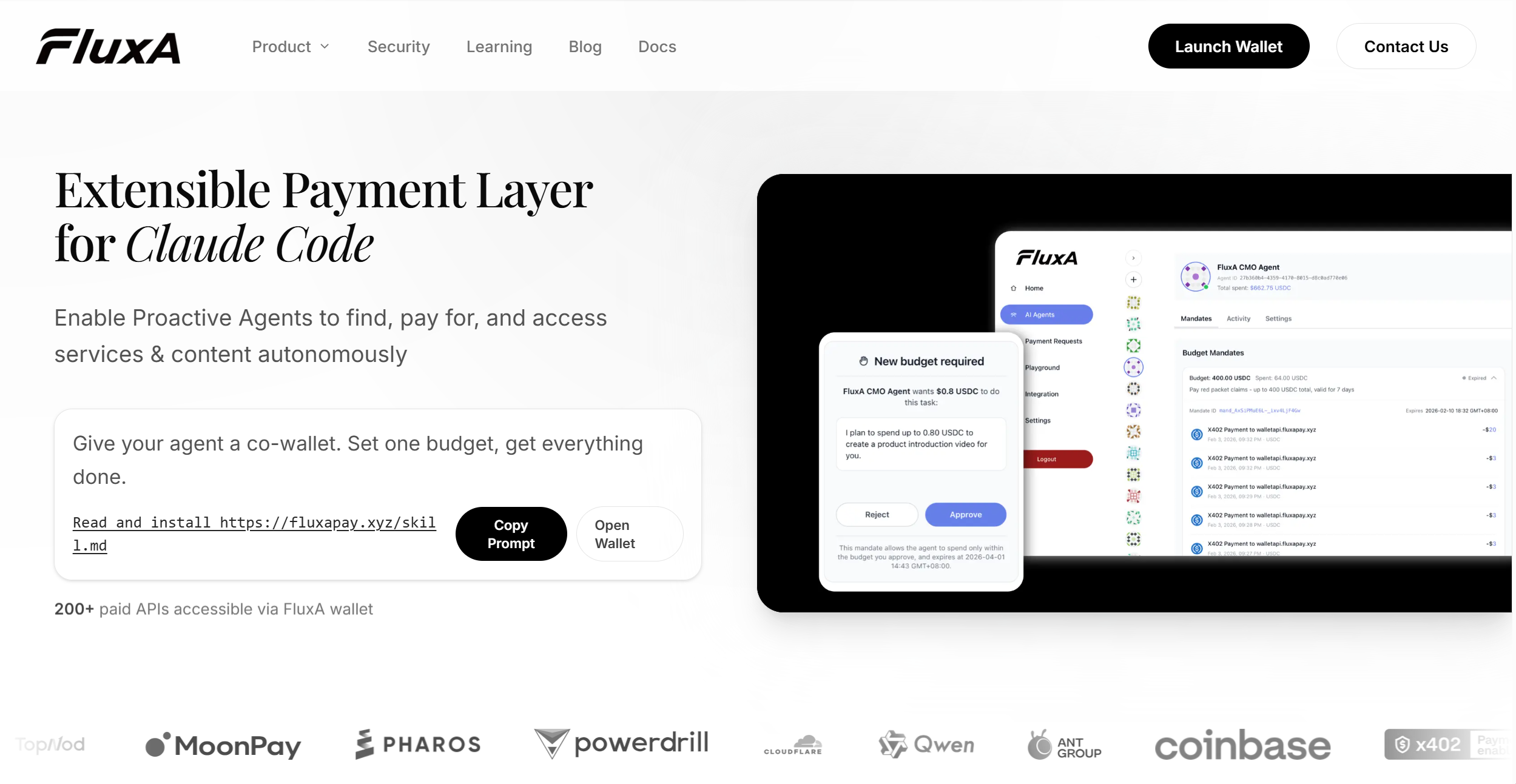
FluxA is the most complete agent wallet and payment platform available today — the only vertically integrated platform that pairs an AI Wallet, a Credit system, and an Agent Card under one native protocol (AEP2).
AI Wallet — a programmable stablecoin wallet for autonomous agent spending. Setting up the agent wallet is a short sequence: the agent obtains a FluxA-issued Agent ID, requests a budget from the human owner, and once the user signs a mandate, it pays for x402-compatible APIs, datasets, MCP tools, and agent-to-agent services without per-transaction approval. FluxA extends x402 V2 with its AEP2 protocol, adding mandate-based pre-authorization and deferred settlement for high-frequency use. Payments deduct from the pre-signed mandate automatically. Human controls: per-agent monthly limits, host-scoped automatic policies, real-time revocation.
Credit — FluxA's Monetize platform lets service providers charge for APIs, MCP servers, and agent skills with flexible per-tool pricing. Agents consume paid services using FluxA credits, which are tracked and billed automatically based on actual usage. This gives agents access to a growing marketplace of commercial tools — search, image generation, data feeds, and more — without managing separate subscriptions or API keys for each provider.
Agent Card — single-use virtual cards issued on demand by the agent directly from the FluxA Wallet. Each card is provisioned for one task, capped at a specific amount, and automatically invalidated after the transaction settles. Unused balance returns to the wallet. No pre-registration. No lingering credentials.
Core advantages over alternatives:
- Amount-locked per task — each card is capped at the exact authorized amount; a compromised agent cannot overspend
- Disposable by design — card number is permanently invalid after one use; no credential reuse risk
- Mandate-governed — cards inherit wallet mandate policies: spending caps, validity windows, one-click revocation
- Full audit trail — every issuance, charge, and closure is logged with agent identity and mandate context
All three products run on AEP2, which separates transactions into instant authorization (mandate embedded in request header) and batched on-chain settlement. ZK aggregation keeps gas negligible at high frequency.
Payment rails: Stablecoin (x402 V2/USDC on Base) + Credit (Monetize platform) + Agent Card
Architecture: AEP2 deferred settlement; ZK aggregation; Agent Card + Credit + AI Wallet
Speed: Near-instant authorization; batched on-chain settlement
What Is Skyfire?
Skyfire is an agent payment network built around agent identity. Its KYA (Know Your Agent) standard verifies every agent's identity via signed JWTs before any transaction. Built on top of KYA, the KYAPay protocol handles the payment flow itself — creating a traceable record of which agent initiated which payment. This makes Skyfire the strongest option for enterprise deployments where auditability is a hard requirement. Wallets are funded via card, ACH, wire, or USDC. Spending controls operate as wallet-level policies, not embedded transaction mandates.
Payment rails: USDC + card/ACH/wire
Architecture: KYA identity verification + KYAPay payment protocol; policy-based wallet controls
Speed: Varies by funding rail
What Is Crossmint?
Crossmint is a full-stack wallet and payments platform using a dual-key TEE architecture: the human holds one key, the agent operates with a second. Its differentiator is rail breadth — stablecoin via x402/USDC and card networks via Visa and Mastercard, through lobster.cash, an open payment standard for AI agents built by Crossmint and powered by Solana, Circle, Visa, Mastercard, Basis Theory, and Stytch. In April 2026, lobster.cash integrated Mastercard Agent Pay and Verifiable Intent, enabling agents to transact using consumers' existing Mastercard cards with issuer controls and cryptographic proof of authorization. Spending controls are platform-enforced policies; there is no mandate-embedded protocol.
Payment rails: Stablecoin (x402/USDC) + Visa/Mastercard (via lobster.cash)
Architecture: Non-custodial dual-key TEE; lobster.cash open payment standard
Speed: Near-instant on stablecoin; standard card settlement on card rails
Protocol and Payment Infrastructure
These platforms provide signing standards, payment middleware, or merchant-side tooling. None include a native agent wallet or end-to-end spending controls out of the box.
What Is Coinbase x402?
x402 is an open-source HTTP payment standard: a server returns HTTP 402 with payment parameters, the agent pays in USDC and retries — no account signup, no redirects. V2 (December 11, 2025) added wallet-based sessions, multi-chain support, and a modular SDK, evolving the protocol beyond single-call settlement. The protocol processed 100M+ transactions in its first six months. Google's AP2 adopted x402 via the A2A x402 extension; Stripe integrated x402 on Base in February 2026. The x402 Foundation, stewarded by the Linux Foundation, launched on April 2, 2026. FluxA's AEP2 extends x402 V2 with mandate-based pre-authorization and deferred settlement, which is how agents pay autonomously across x402 and AEP2 at high frequency without confirming every request on-chain.
Payment rails: USDC (Ethereum, Base, Solana, Polygon, Arbitrum, and others)
Architecture: Open-source HTTP standard; wallet-based sessions (V2); no native wallet layer
Speed: On-chain confirmation per transaction (V1); session-based batching available (V2)
What Is Nevermined?
Nevermined is a payment middleware platform for AI service monetization — APIs, MCP servers, datasets, agent-to-agent transactions. It supports x402, A2A, AP2, and MCP natively, making it the broadest protocol-compatible option for teams monetizing services across multiple ecosystems. In April 2026, Nevermined launched its integration with Visa Intelligent Commerce and Coinbase's x402, enabling AI agents to autonomously purchase digital goods and services using delegated Visa cards with cardholder-defined spending rules. No native agent wallet; spending controls are billing policies, not cryptographic mandates.
Payment rails: Stablecoin (x402/USDC) + Visa (via Intelligent Commerce, April 2026)
Architecture: Protocol-compatible middleware; usage-based billing; no native wallet
Speed: Varies by rail
What Is Stripe?
Stripe operates on both sides of agent commerce. Its Agentic Commerce Suite (December 2025) and Agent Toolkit SDK help merchants sell through AI agents — supporting product creation, payment links, virtual card issuance, and MCP-based payments, with integrations for OpenAI Agents SDK, LangChain, and CrewAI. On the buyer side, Stripe co-authored the Machine Payments Protocol (MPP) with Tempo (launched March 18, 2026), an open standard that lets agents pre-authorize a spending session and stream micropayments across stablecoin, fiat, and Lightning rails. Stripe also added USDC on Base (February 2026) and supports x402. However, Stripe does not offer a native agent wallet — it remains payment infrastructure, not an end-to-end agent spending platform.
Payment rails: Card networks + USDC (Base) + MPP (stablecoins on Tempo + fiat + Lightning)
Architecture: Hosted payment infrastructure; Agent Toolkit SDK; MPP session billing; no agent wallet
Speed: Standard card settlement; near-instant on Base; sub-second on Tempo (MPP)
How to Choose the Right Agent Wallet
Start with what your agent needs to buy. Most platforms only support stablecoin rails. If it needs to pay merchants that don't accept crypto, card-rail support is required — which narrows the field to FluxA, Skyfire, or Crossmint.
Think about how authorization is enforced. Wallet-level policies (Skyfire, Crossmint) set per-agent limits in a dashboard. Protocol-level mandates (FluxA) embed authorization cryptographically in each transaction — verifiable on-chain, not just policy-logged. That difference in enforcement is exactly how Crossmint, Nevermined, and FluxA compare once you look past the dashboard. For teams where per-action auditability matters, this is a meaningful difference.
Consider the monetization model. If your agents need access to a broad marketplace of paid APIs, MCP tools, and skills without managing per-provider subscriptions, FluxA's Credit system and Monetize platform cover this out of the box.
Decide how much you want to build. x402 and Nevermined give you payment primitives to assemble yourself, so it pays to know how x402, ACP, AP2, and MPP fit together before you settle on a stack. Stripe's MPP provides session-based billing infrastructure but no agent wallet. FluxA, Skyfire, and Crossmint ship the wallet, controls, and payment execution as one integration.
Match the tool to the use case:
| If you need… | Best fit |
|---|---|
| Stablecoin micropayments + credit-based API/MCP consumption + single-use virtual card spending, full audit trail | FluxA |
| Enterprise agent identity verification (KYA) before every transaction | Skyfire |
| Both stablecoin and Visa/Mastercard card-network rails in one platform | Crossmint |
| Monetize an MCP server or API across multiple protocol ecosystems | Nevermined |
| Open-source x402 baseline, build your own authorization layer | Coinbase x402 |
| Session-based streaming payments across fiat and crypto rails, with Stripe integration | Stripe (MPP) |
FAQ
What is the best agent wallet in 2026?
FluxA is the strongest all-round choice. It uniquely combines an AI Wallet, Credit system, and Agent Card under one protocol with mandate-level spending controls.
What is an agent wallet?
A programmable account that lets AI agents hold funds and pay autonomously. Unlike standard wallets, it enforces human-defined spending limits at the protocol or policy level.
How do FluxA's AI Wallet, Credit, and Agent Card differ?
They cover three distinct spending scenarios under one protocol. The AI Wallet handles stablecoin micropayments, Credit covers paid APIs and MCP tools, and Agent Card issues single-use virtual cards.
How does FluxA differ from Coinbase x402?
x402 is a protocol; FluxA is a full platform built on it. FluxA's AEP2 extends x402 V2 with mandate-based authorization, credit payments, and a complete wallet — capabilities raw x402 leaves to developers.
Can AI agents pay with traditional card networks?
Yes, but few platforms support it. FluxA's Agent Card, Crossmint's lobster.cash, and Skyfire all offer card-rail access; most stablecoin-native protocols do not.
How does Stripe compare to agent wallet platforms?
Stripe provides payment infrastructure but not a native agent wallet. Its MPP enables agent-initiated payments, yet wallet creation, spending controls, and authorization must be built separately.
What should I look for when evaluating agent wallets?
Prioritize authorization model, rail coverage, and built-in wallet support. Key criteria include mandate vs. policy enforcement, supported rails, protocol compatibility, and audit trail granularity.